Let's be honest. Most ski lifts are functional. You stare at the back of someone's jacket, maybe check your phone. But then there are those lifts. The ones that make you forget you're even holding skis. The ones where the journey is the entire point. These are the most scenic ski lifts worldwide, transforming a simple ascent into an unforgettable aerial sightseeing tour.
I've spent over a decade chasing vertical feet and, more importantly, breathtaking views. I've learned that the "best" view is subjective, but the lifts that consistently drop jaws share common traits: sheer scale, unique geological features, and a sense of exposure that makes you feel part of the landscape, not just an observer.
Your Scenic Lift Roadmap
What Makes a Ski Lift "Scenic"? It's Not Just Height
It's easy to think the highest lift wins. Not always. A great scenic lift combines several elements.
Panorama vs. Focus: Some offer a 360-degree, overwhelming vista of endless peaks (think Alps). Others provide an intimate, close-up view of a single, dramatic feature like a glacier or a sheer cliff face.
The Ride Experience: A slow, old-school gondola lets you soak it in. A high-speed chair with a bubble shield offers comfort and unobstructed views. A tiny, swaying two-seater? That's pure, raw adventure.
Uniqueness of Terrain: Flying over a crevasse-riddled glacier, traversing a rocky arête, or floating above a pristine alpine lake adds a layer of awe you won't get from a lift over a forested slope.
Top European Scenic Ski Lifts: Alpine Majesty
Europe's Alps are the spiritual home of epic mountain scenery. The lifts here are engineering marvels accessing terrain that was once the sole domain of mountaineers.
Aiguille du Midi Téléphérique, Chamonix, France
This isn't just a ski lift; it's a pilgrimage. In under 20 minutes, it rockets you from 1,035m in Chamonix town to 3,842m on the shoulder of one of the Mont Blanc massif's most iconic peaks. The final section is a near-vertical ascent up the rock face. You step out into a world of rock, ice, and staggering views of the French, Swiss, and Italian Alps. It's the gateway to the legendary Vallée Blanche off-piste run. The cost is high (around €65 for a round-trip), and you need to book a time slot in peak season, but it's non-negotiable for any serious mountain lover.
Kulmhotel Gornergrat Bahn, Zermatt, Switzerland
A cogwheel train, not a cable car, but it belongs on any scenic list. The 33-minute ride from Zermatt (1,604m) to the Gornergrat (3,089m) is a front-row seat to the Matterhorn. The north face of the iconic pyramid is directly across the valley, growing larger with every minute. You also get views of the Gorner Glacier, Switzerland's second largest. I prefer this to the newer Matterhorn Glacier Paradise cable car because the slower pace and multiple vantage points from the train windows allow for a more immersive experience. A round-trip is about CHF 126 in winter.
Stelvio Cable Car, Bormio, Italy
This one is about raw, high-altitude drama. It serves the highest ski area in Italy, climbing from Bormio (1,225m) to the summit of Monte Cristallo (3,200m) in three stages. The final section soars over the rugged, lunar-like landscape of the Stelvio National Park. On a clear day, you can see across to the Swiss Engadin. It's less polished than the Swiss giants, which adds to its charm. A day pass for the area is around €55-60.
Top North American Scenic Lifts: Big Sky Country
The scale in North America is different—wider, more expansive. The views feel endless.
Jackson Hole Aerial Tram, Wyoming, USA
"The Big Red Tram" is an institution. In 12 minutes, it crams 100 people up 4,139 vertical feet to the summit of Rendezvous Mountain (3,185m). The view of the Grand Teton piercing the sky to the north is simply unmatched in American skiing. Looking down, you see the entire Jackson Hole valley, the Snake River, and an intimidating sea of expert chutes below. It's a working lift for skiers, so the vibe is energetic. A single ride for a sightseer is pricey (around $45), but it's included with a ski pass. Go on a bluebird day after a storm for the full effect.
Whistler Blackcomb Peak 2 Peak Gondola, British Columbia, Canada
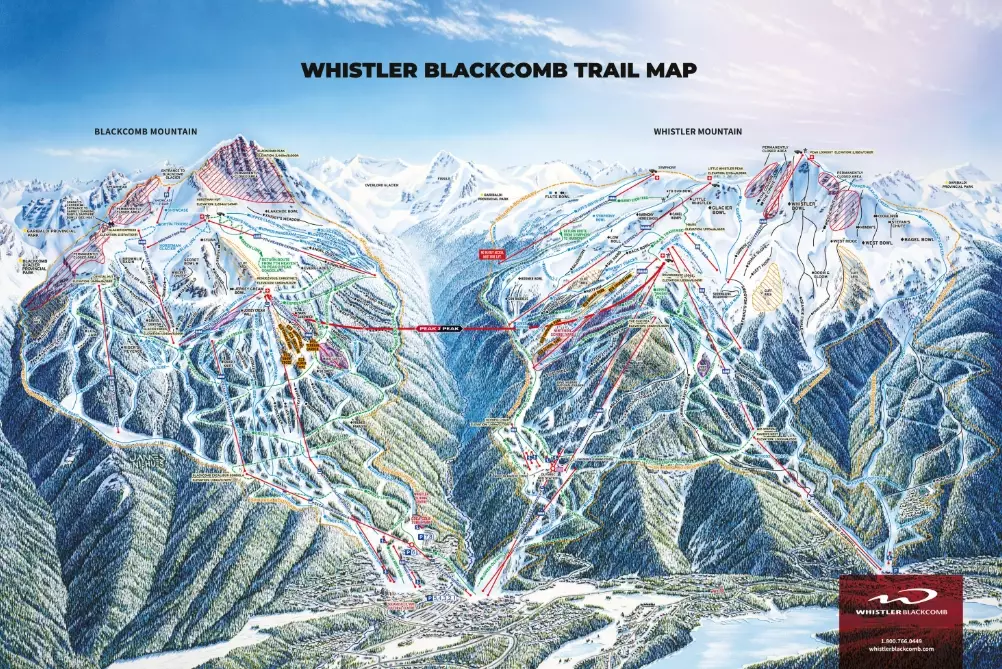
This is a feat of engineering that created a scenic attraction in itself. It connects the peaks of Whistler and Blackcomb mountains across a 4.4km span, 436m above the valley floor. The views down Fitzsimmons Creek and to the surrounding Coast Mountains are immense. For the best experience, pay extra for the glass-bottom cabin—looking straight down 1,400 feet while moving is a genuine thrill. It's operational for summer sightseeing too. Access requires a winter or summer sightseeing ticket from Whistler Blackcomb.
Silver Queen Gondola, Aspen Mountain, Colorado, USA
A classic. This 20-minute ride from downtown Aspen to the summit of Ajax (3,413m) offers a perfect snapshot of Colorado's Elk Mountains. The view of the Maroon Bells—the most photographed peaks in North America—from the top is the prize. It's a smoother, more relaxed experience than the tram at Jackson Hole. You can have lunch at the Sundeck restaurant at the top and just stare. A single ride is about $50 in the summer; in winter, it's part of the ski lift network.
| Lift Name | Location | Type | Key Scenic Feature | Approx. Round-Trip Cost | Best Time for Views |
|---|---|---|---|---|---|
| Aiguille du Midi | Chamonix, FR | Cable Car | Panorama of Mont Blanc Massif | €65 | Early morning (clear sky) |
| Gornergrat Bahn | Zermatt, CH | Cogwheel Train | Direct view of the Matterhorn | CHF 126 | Morning (sun on N. Face) |
| Jackson Hole Tram | Wyoming, USA | Aerial Tram | Grand Teton & Jackson Hole Valley | $45 (sightseer) | Mid-day (full light) |
| Peak 2 Peak | Whistler, CA | Gondola | Span between two mountain peaks | Varies (lift ticket) | Any clear day |
Planning Your Scenic Lift Journey: Avoid the Regrets
Showing up and hoping for the best is a sure way to be disappointed. These lifts are weather-dependent and often crowded.
Check the Forecast, Then Check the Webcams: A "sunny" forecast in the valley can mean the peaks are shrouded in cloud. Most major resorts have live webcams at the summit. Look at them the morning of your trip. The official sites for Chamonix or Zermatt are reliable sources.
Buy Tickets Online in Advance: This is non-negotiable for lifts like Aiguille du Midi or the summer Peak 2 Peak. You'll often get a time slot, guaranteeing access and saving hours in line.
Go Early or Go Late: The first upload of the day is almost always the calmest. Alternatively, a late afternoon ride can have magical golden hour light and fewer people, though check last ride times.
Dress Like the Summit, Not the Base: It can be 20-30 degrees Celsius colder at the top, with brutal wind. Wear all your layers, even if it's warm below. Gloves and a hat are essential.
Ski Lift Photography: Capturing the Vistas
Shooting through scratched Plexiglas is the classic struggle. Here’s how to beat it.
Get in the Front or Back: On a gondola, the front or rear cabin has the cleanest, most unobstructed windows. On a chairlift, if it's a bubble, make sure the bubble is fully closed and locked to minimize wind vibration.
Lens Choice: A wide-angle (16-35mm) is great for capturing the expanse of the cabin interior with the view. But a medium telephoto (70-200mm) is secretly your best friend—it lets you compress distances and pick out stunning details on distant peaks or glaciers.
Settings: Use a fast shutter speed (1/1000s or faster) to freeze motion and vibration. Set your white balance manually ("Daylight") to avoid the blue/green tint from tinted windows. Press your lens hood flush against the glass to eliminate reflections.
My personal trick? A circular polarizing filter. It cuts the glare and reflections off snow and ice like nothing else, revealing incredible detail and color in the mountains. It's the single best investment for mountain photography.
Your Scenic Lift Questions Answered
I get motion sickness easily. Are these high-alpine cable cars a bad idea?
They can be challenging. The modern ones like Aiguille du Midi are surprisingly smooth, but the acceleration and height can trigger vertigo. Choose a cabin in the middle of the cable for less swing. Focus on the horizon line outside, not the moving ground below. Avoid reading or looking at your phone. Taking a non-drowsy motion sickness pill 30-60 minutes before can make the experience enjoyable instead of miserable.
Are these scenic lifts worth the cost if I'm not a skier?
Absolutely, but you need to reframe the value. You're paying for a unique mountain transportation and sightseeing experience that would otherwise require a full-day, expert-level hike or climb. Compare it to the cost of a helicopter tour—it's a bargain. Maximize your time at the top: have a coffee, walk the viewing platforms, read the informational plaques. The Gornergrat, for example, has an observatory and multiple terraces to explore.
What's the biggest mistake people make when visiting these famous lifts?
Rushing. They tick the box, snap a selfie, and queue to go back down. The magic happens when you pause. The light changes, clouds roll in and out, revealing new facets of the landscape. Plan to spend at least an hour at the summit station. Find a quiet corner, sit down, and just watch the mountains for 15 minutes. That's when you move from seeing a view to feeling a place. Also, underestimating the altitude—drink plenty of water and move slowly up there.
Is it better to do these in winter or summer?
They offer completely different experiences. Winter provides sharper, snow-capped peaks, incredible contrast, and the energy of a ski resort. Summer offers accessibility (you can hike from the top), greener valleys, and often more stable, clear weather. Summer also means wildflowers. For pure, dramatic mountain scenery, late spring/early summer when there's still plenty of snow on the peaks but the valleys are green is hard to beat. Winter has shorter days and higher avalanche risk which can close terrain.
How can I avoid the worst of the crowds on these popular lifts?
Beyond going early, target the shoulder seasons. Late April in the Alps or early December in North America, just as the resorts are opening or closing, often have smaller crowds and decent weather. Mid-week is a universal rule. Also, research if there's a less famous but equally scenic lift nearby. For example, in the Chamonix valley, the Grands Montets cable car offers jaw-dropping views of the Argentière Glacier and is often quieter than the Aiguille du Midi, especially in the afternoon.
Related Articles

Comments
Join the discussion